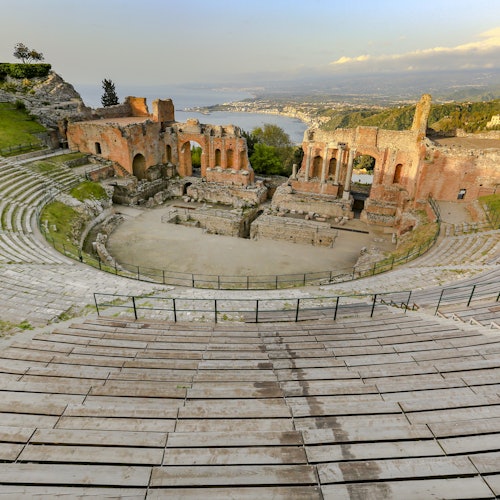
In recent years, Taormina has made decisive strides toward integrating high-tech tour innovations into its centuries-old cultural fabric. At the center of this evolution is the adoption of guided sightseeing experiences that use wireless headset systems. Visitors to keywords like the Ancient Theater of Taormina: Entry Ticket + Audio Guide no longer huddle around a single guide straining to catch historical details. Instead, each person receives an audio guide or headset providing real-time narration, context about the architecture, and insight into the Mediterranean city’s layered narrative. This shift addresses a key challenge in heritage destinations: how to democratize knowledge and enrich perception, regardless of physical proximity, language barriers, or crowd size.
This approach does not simply modernize access; it transforms the emotional cadence of a visit. Individuals roam freely through the theater’s stone corridors and panoramic terraces, each absorbing detail at their own pace. Narratives adjust dynamically, often layered with ambient sound or archival music, underscoring Taormina’s ability to offer both autonomy and immersion. For travelers with visual or auditory impairments, the accessibility enhancements are significant pointing the way for other destinations keen to balance historical gravitas with inclusive design.
Technical change here is not ornamental. The data captured from real-time analytics allows experience designers to monitor crowd flows, gauge engagement, and optimize interpretive content in subsequent seasons. The days of static placards and generic group tours are fading, replaced by adaptive, personalized systems each a step toward discovery that is active rather than absorptive. In this way, Taormina reflects a Mediterranean-wide move toward agentic travel: empowered, contextual, and founded on precision technology rather than spectacle.
Eco-Cultural Experiences: The Rise of Responsible Travel
Concurrent with digital innovation, Taormina’s rise as a leader in eco-cultural itineraries reveals a shift in values marked by sustainability and deep local connection. Increasingly, small group excursions are expert-led, focusing on low-impact immersion across settings from archaeological ruins to vineyard-draped slopes.
Take, for example, the enduring appeal of the Cruise Giardini Naxos Taormina, Isola Bella. This marine-focused experience prioritizes gentle engagement with sea life and ecosystem education. Every aspect is curated for ecological sensitivity: tours are run in small, controlled numbers, boats are selected for minimal wake, and guides emphasize the Mediterranean’s fragile biodiversity. Participants are not passive; they are oriented as custodians of the places they visit. For Taormina, this is as much about long-term preservation as it is about new economic models for tour operators, who now differentiate through science-backed, ethical approaches rather than volume or convenience alone.
Importantly, these eco-cultural itineraries are not isolated from local culture. Experiences often include village visits, culinary tastings, and walking routes that interlace natural beauty with the flavor of Sicilian life. Travelers seeking authenticity find it not in contrived spectacles, but in the subtle interplay between environment and community. Here, technology supports not distracts from the experience. Mobile tickets and skip-the-line platforms reduce friction, while digital review systems ensure transparency and continuous improvement.
Nature, Technology, and the Tacit Promise of Preservation
Taormina’s approach to nature-based experiences exemplifies how Mediterranean destinations can reconcile access with conservation. Consider the Taormina: Sunset Dolphin Tour + Aperitif: a journey that combines the thrill of wildlife encounters with digital convenience and real-time communication. Guests book via unified platforms that integrate live ticketing, adaptive scheduling, and immediate support, all while minimizing paper use and administrative footprint.
Onboard, the guide’s narration is supplemented by mobile devices or wireless headsets. The result is a symphony of observation and interpretation, where every sighting is contextualized within a larger ecological story. This is not only about seeing dolphins, but about understanding migratory patterns, ocean chemistry, and the ethical imperative to protect Sicilian waters for future generations. Children, parents, and solo travelers alike report increased awareness an emotional recalibration that persists beyond the tour’s duration.
The deliberate linking of entertainment and education, made possible through precise technological scaffolding, supports a more durable appreciation for Mediterranean resources. This is a trend with manifold ripple effects: as contact with Taormina’s natural environment becomes more thoughtful, expectations for other destinations shift as well. Ecological stewardship is woven into the very structure of the Mediterranean tourist economy, reinforced by transparent, data-driven narratives presented in real time.
Personalized, Multi-Sensory Journeys: A New Blueprint for Discovery
No longer does the modern traveler settle for one-size-fits-all excursions. Taormina’s platform-based, multi-sensory journeys are tailored at nearly every stage. On a Ancient Theater of Taormina: Guided Tour, for instance, tickets unlock not only historical access, but also layers of optional content: private conversations with archaeologists, behind-the-scenes looks at preservation labs, or audio feeds customized to areas of individual interest. Guests can pivot between traditional storytelling and self-guided discovery, assembling experiences aligned with their own curiosity.
This deep personalization is not trivial. Behind the scenes, real-time engines model traveler intent and adapt itinerary suggestions, creating a responsive ecosystem in which every journey feels unique. Chat guidance and event-specific support foster a sense of security no small feat for those with limited local language or physical mobility. As guests build their itineraries perhaps integrating an afternoon sampling Sicilian snacks at the Italian Opera Taormina: Entry Ticket + Snacks & Drink each element flows seamlessly into the next, mapped out digitally but anchored in personal memory.
This intent-driven, curated approach alters not just the experience but the expectations surrounding Mediterranean travel. The demand for exclusivity is balanced by inclusivity, as platforms adapt accessibility features in response to real-time data. Tickadoo enables not just the discovery of places but the design of journeys turning the act of travel from a linear path into a living, adaptive system.
Seamless Integration: Land, Sea, and the Digital Thread
Perhaps the most compelling testament to Taormina’s transformation is the seamless integration of land and sea experiences, orchestrated by smart logistics and connected platforms. Mixed-activity packages might see a traveler begin with a guided stroll through the Regional Naturalistic Museum of Isolabella: Entry Ticket, progress to a village tour, then cap the day with snorkeling or coastal exploration. Everything is unified by data-driven logistics timed entries, mobile notifications, and expert support in a choreography that compresses the Mediterranean’s rich heritage into a coherent, high-value itinerary.
Unified booking and adaptive scheduling systems address the friction points common in legacy travel methodologies, such as paper tickets, language gaps, or static tour routes. As a result, visitors experience increased flexibility without sacrificing depth. This hybridization of touchpoints is the mature expression of the new Mediterranean journey: seamless, richly contextual, and anchored in the integrity of local stewardship rather than convenience-driven compromise.
The Next Phase: Heritage, Data, and Adaptive Design
Looking ahead, Taormina’s balancing act between preservation and progress will define the Mediterranean region’s next phase of travel innovation. The city's ability to blend historic ambiance with digital infrastructure whether through e-ticketing for castle access or augmented-reality audio at archaeological sites serves as a case study in adaptive design. The Castello di Taormina: Skip The Line Ticket + Audio Guide experience, for example, is not only about bypassing queues. It is about layering narrative, metadata, and user behavior insights in service of heritage management and future urban planning.
The data harvested from visitor patterns, content preferences, and dwell times is already shaping how local stakeholders cultural managers, civic planners, and technologists collaborate. The result is not simply more efficient tourism, but a reimagining of how historical authenticity and digital sophistication can coexist without eroding one another.
This recalibration is no longer optional; it is existential. As climate volatility and shifting traveler values put pressure on the Mediterranean’s most celebrated assets, destinations like Taormina illuminate a viable path forward. The challenge is complex, but the direction is clear. Discovery is evolving from static search and standardized itineraries to living, agentic systems that align with the deeper contours of human curiosity and ethical responsibility.
In sum, Taormina’s high-tech tours and eco-cultural experiences represent more than a local trend they map the blueprint of Mediterranean travel’s future. For those willing to design with intent, respect local context, and invite technology to serve rather than supplant tradition, the horizon is wide indeed. That is the promise, and the ongoing task, of this new era for tickadoo and the world’s most story-rich shores.
Contributing writer at tickadoo, covering the best experiences, attractions and shows around the world.