Death Note: The Musical Is Coming to London – Everything You Need to Know
by Sarah Gengenbach
February 26, 2026
Share

Death Note: The Musical Is Coming to London – Everything You Need to Know
by Sarah Gengenbach
February 26, 2026
Share

Death Note: The Musical Is Coming to London – Everything You Need to Know
by Sarah Gengenbach
February 26, 2026
Share

Death Note: The Musical Is Coming to London – Everything You Need to Know
by Sarah Gengenbach
February 26, 2026
Share

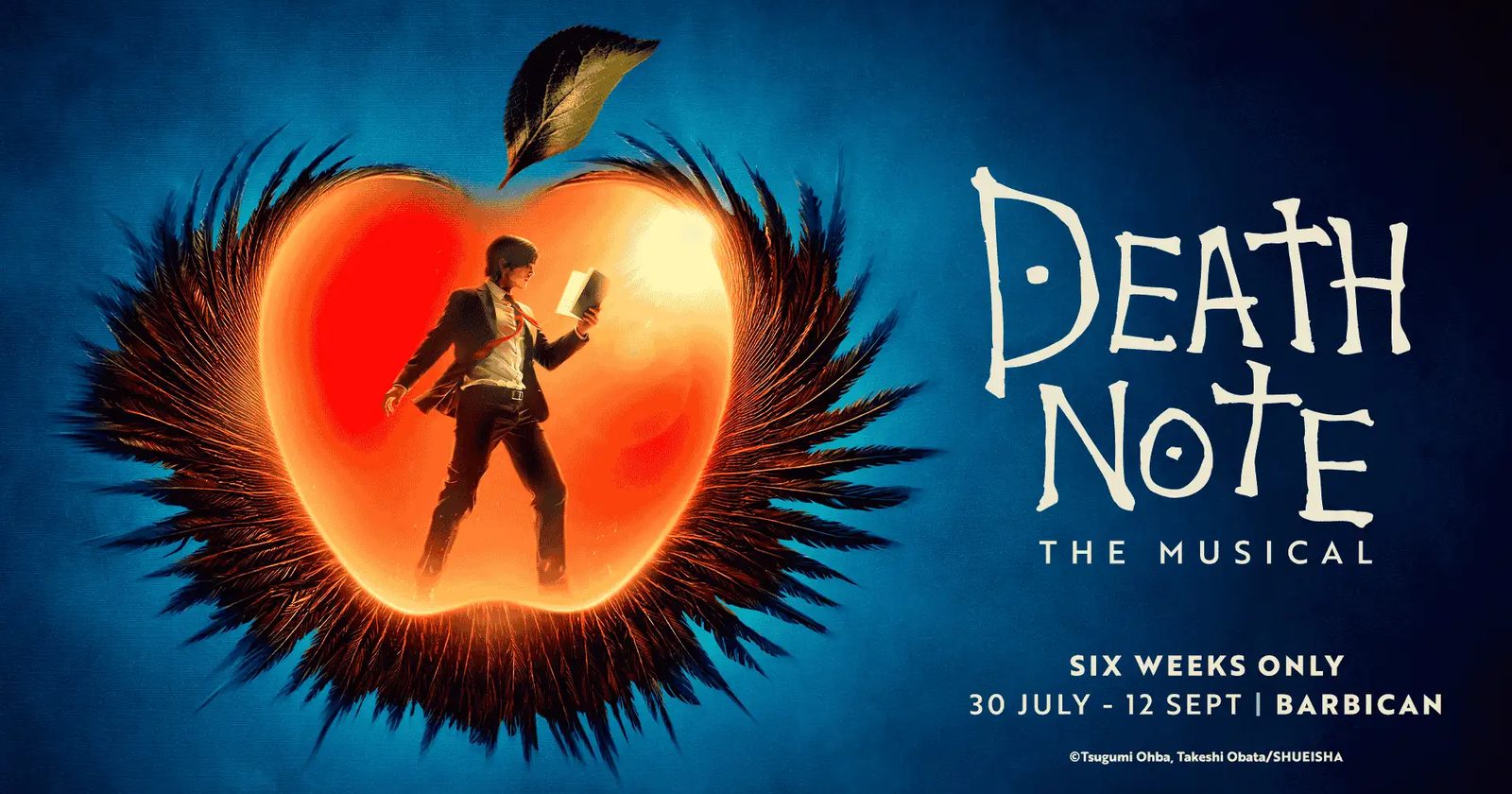
If you’ve ever argued with someone about whether Light Yagami is a hero or a villain, this summer is going to feel very personal. Death Note: The Musical arrives at London’s Barbican Theatre on 30 July 2026 for a strictly limited six-week run — and it’s shaping up to be one of the most anticipated theatre events of the year.
This isn’t a concert or a stage reading. It’s a full world premiere of a brand-new production: revised script, newly written songs, and a creative team that includes the director of Hamilton and Moulin Rouge! The Musical. For fans of the manga and anime, it’s the moment many have been waiting for. For London theatregoers who’ve never read a panel of Death Note in their lives, it’s a gripping psychological thriller with one of the most morally complex stories to hit the West End stage.
Here’s what you need to know before you book.
What Is Death Note: The Musical?
The show is based on the international bestselling manga by Tsugumi Ohba and Takeshi Obata, which has sold over 30 million copies worldwide and spawned anime adaptations, films, and a widely watched Netflix series. The musical premiered in Tokyo in 2015 and ran for a decade in sold-out productions across Asia, winning Best Musical at the Korea Musical Awards. London audiences got a preview in 2023 — a series of sold-out concerts at the London Palladium that broke records. This summer’s production goes significantly further.
The story centres on Light Yagami, an exceptionally gifted student who discovers a supernatural notebook with a single devastating rule: any human whose name is written inside will die within 40 seconds. The notebook was dropped into the human world by a Shinigami named Ryuk. Light, disillusioned by a justice system he believes lets criminals escape punishment, begins using the Death Note to eliminate wrongdoers across the globe. The public names him ‘Kira’ — both a symbol of justice and a source of terror. With no physical evidence to follow, the authorities turn to a mysterious genius detective known only as L. What follows is one of fiction’s great psychological duels: two brilliant minds, opposite methods, each convinced they are right.
The musical takes that premise and gives it scale, operatic ambition, and a score designed to make those moral questions feel genuinely urgent. It’s dark, clever, and emotionally gripping — and it works whether you’ve read every volume of the manga or are walking in knowing nothing at all.
Why This Production Is Worth Paying Attention To
The creative team alone sets this apart from a standard adaptation. Director Stephen Whitson brought both Hamilton and Moulin Rouge! The Musical to the UK stage — two of the defining musical theatre events of the past decade. His approach to large-scale, visuallyambitious productions with psychological depth is exactly what Death Note demands. Choreography comes from Fabian Aloise, Olivier Award-nominated for his work on Evita at the London Palladium and Sunset Boulevard at The Savoy. Set design is by Jon Bausor, the Emmy-nominated designer whose recent credits include Spirited Away and Bat Out of Hell — someone who clearly understands how to realise a heightened, visually striking world with theatrical conviction.
The score is by Frank Wildhorn, whose work spans Jekyll and Hyde, Bonnie and Clyde, and the Whitney Houston hit ‘Where Do Broken Hearts Go’. Wildhorn has been associated with the show since its Tokyo debut, and this new production gives the material a fresh treatment — newly written songs sit alongside the original score, with the revised book and additional lyrics by Morgan Reilly sharpening the story for a West End (and ultimately Broadway) audience. Orchestration and arrangements are by Jason Howland.
It’s also worth noting that this production is a genuine world premiere, not a transfer of the existing Asian production. The Barbican run is the first time this version of Death Note: The Musical will be seen anywhere. That matters if you’re the kind of theatregoer who wants to be in the room when something is new.
The Barbican Theatre: What to Expect from the Venue
The Barbican Theatre is unlike most West End venues, and that’s part of what makes this booking interesting. Located in the City of London rather than the traditional West End corridor, the 1,166-seat theatre is one of London’s most architecturally striking performance spaces — part of the Brutalist Barbican Centre complex, opened in 1982. Productions here tend to have scale and visual ambition that other venues can’t accommodate, and that’s precisely why Trafalgar Theatre Productions has used it for ambitious summer seasons before.
In brief: the Stalls offer full immersion close to the action; the Circle and Upper Circle provide elevated sightlines that capture the full staging — particularly valuable for a show with the kind of design ambition Bausor brings. Given the show’s visual scale, sitting centrally in the Circle rows A-E is an excellent option if you want to take in the full picture.
Nearest Tube stations are Barbican (Circle, Hammersmith and City, Metropolitan lines) and Moorgate (also Northern line) — both a short walk from the theatre entrance. Liverpool Street is walkable in around ten minutes. The Barbican complex has multiple bars, restaurants, and café spaces, so arriving 30-45 minutes early lets you explore properly before curtain.
Step-free access is available throughout the venue, with lifts, induction loops, and accessible facilities at entry points.
How Does Death Note: The Musical Compare to Other IP-to-Stage Adaptations?
The track record of anime and manga properties on stage has been mixed globally, but London has seen some genuinely excellent examples in recent years.
My Neighbour Totoro at the Gillian Lynne Theatre is a useful reference point — a Studio Ghibli adaptation that won over both fans of the source material and audiences with no prior relationship to the story, through extraordinary craft and a clear theatrical vision. Death Note has a different challenge: the source material is darker and more conceptually complex, built around a moral grey area rather than a clear emotional journey. That’s actually an advantage in musical theatre terms. The genre handles moral ambiguity and psychological interiority well — which is part of why Frank Wildhorn’s operatic instincts feel like a strong match for this particular story.
Stranger Things: The First Shadow at the Phoenix Theatre is another useful comparison — a production that demonstrated how much a beloved IP benefits from theatrical craft that respects the source while finding something genuinely new to say in a live performance context. Death Note has 10 years of Asian productions to draw on, but the creative team is building something that stands on its own terms. The word ‘reimagining’ is often overused, but in this case the changes — new script, new songs, and a director who has no history with the property — suggest a production that’s genuinely reconceiving the material rather than staging the familiar version.
Insider Tips for Booking Death Note: The Musical
The show runs for six weeks only, from 30 July to 12 September 2026, with a press night on 11 August. Book as early as possible. The Palladium concerts in 2023 sold out, and the announcement of this production has already generated substantial attention both within the theatre world and the manga and anime fandom. Seats at the popular price points will go quickly.
For the best value, look at matinee performances on Thursdays — these tend to attract lower demand than Saturday matinees and weekend evenings, and you’ll often find better availability and seat selection. Evening performances run Monday through Saturday at 7:30pm; matinees are on Thursdays and Saturdays at 2:30pm.
Aim to sit centrally. The Barbican Theatre’s layout rewards central seats in both the Stalls and the Circle. Front Stalls rows D-G offer full proximity to the action and strong sightlines for a show with this kind of design ambition. If you want to take in the full scale of the staging, central Circle rows A-D give you exactly that. For groups wanting value without compromising the experience, the Upper Circle centrally positioned is worth considering — the sightlines remain strong for large-scale productions.
Arrive at least 25 minutes before the performance. The Barbican complex is large and worth exploring, and you’ll want time to find your seats without rushing. Running time is approximately 2 hours 30 minutes including one interval, so you’ll be out by around 10:15pm for a 7:30pm start.
The show carries an age guidance of 12+, which reflects the material’s themes around death, justice, and moral complexity. It’s entirely suitable for older teenagers — in fact, if you have a teenager who knows Death Note, this is a very strong choice for a theatre introduction that meets them on their own terms.
Book through tickadoo’s London musicals listings, where you can compare seat options across the run and get your e-tickets delivered instantly to your phone. tickadoo’s free membership means every booking earns rewards, whether you’re booking Death Note tonight or planning your next trip.
What to Know if You’re New to Death Note
The simplest description is this: a brilliant student finds a notebook that lets him kill anyone whose name he writes in it, decides to use it to create a better world, and discovers that absolute power corrupts absolutely. What makes the story extraordinary is that Light is compelling — genuinely, frighteningly compelling. You understand his logic even as you watch it curdle into something monstrous. L, his adversary, is equally complex: equally certain of his own righteousness, equally willing to use questionable methods to get results.
The musical format adds something that the manga and anime can’t quite replicate: live music and performance make the emotional manipulation more visceral. You’re in the room with these characters, not watching them at a remove. That shifts the moral experience considerably. Going in without strong preconceptions about which character you should root for is actually an advantage — the show is designed to work on an audience encountering it fresh.
If you want to prepare, the original manga is the cleanest version of the story. The anime is faithful and excellent. Both are substantial commitments, though — and given that this production is a genuine reimagining, prior knowledge adds context but isn’t required.
Don’t Miss This One
Death Note: The Musical represents a rare convergence: a globally beloved story, a score with genuine theatrical weight, and a creative team with the credentials to do it justice in a production designed specifically for the West End stage. The six-week window is short, and the interest from both theatre audiences and the international fandom is considerable.
The key takeaways: book early, aim for central seats in the Stalls or Circle, and arrive with time to explore the Barbican Theatre properly. Whether you’ve been waiting for this since the 2023 concerts or you’re coming to it fresh, it promises to be one of the summer’s defining theatrical events.
Browse tickets and secure your seats for Death Note: The Musical at the Barbican on tickadoo. Join the free tickadoo+ membership and start earning rewards on every booking — for theatre, travel, and everything beyond.

If you’ve ever argued with someone about whether Light Yagami is a hero or a villain, this summer is going to feel very personal. Death Note: The Musical arrives at London’s Barbican Theatre on 30 July 2026 for a strictly limited six-week run — and it’s shaping up to be one of the most anticipated theatre events of the year.
This isn’t a concert or a stage reading. It’s a full world premiere of a brand-new production: revised script, newly written songs, and a creative team that includes the director of Hamilton and Moulin Rouge! The Musical. For fans of the manga and anime, it’s the moment many have been waiting for. For London theatregoers who’ve never read a panel of Death Note in their lives, it’s a gripping psychological thriller with one of the most morally complex stories to hit the West End stage.
Here’s what you need to know before you book.
What Is Death Note: The Musical?
The show is based on the international bestselling manga by Tsugumi Ohba and Takeshi Obata, which has sold over 30 million copies worldwide and spawned anime adaptations, films, and a widely watched Netflix series. The musical premiered in Tokyo in 2015 and ran for a decade in sold-out productions across Asia, winning Best Musical at the Korea Musical Awards. London audiences got a preview in 2023 — a series of sold-out concerts at the London Palladium that broke records. This summer’s production goes significantly further.
The story centres on Light Yagami, an exceptionally gifted student who discovers a supernatural notebook with a single devastating rule: any human whose name is written inside will die within 40 seconds. The notebook was dropped into the human world by a Shinigami named Ryuk. Light, disillusioned by a justice system he believes lets criminals escape punishment, begins using the Death Note to eliminate wrongdoers across the globe. The public names him ‘Kira’ — both a symbol of justice and a source of terror. With no physical evidence to follow, the authorities turn to a mysterious genius detective known only as L. What follows is one of fiction’s great psychological duels: two brilliant minds, opposite methods, each convinced they are right.
The musical takes that premise and gives it scale, operatic ambition, and a score designed to make those moral questions feel genuinely urgent. It’s dark, clever, and emotionally gripping — and it works whether you’ve read every volume of the manga or are walking in knowing nothing at all.
Why This Production Is Worth Paying Attention To
The creative team alone sets this apart from a standard adaptation. Director Stephen Whitson brought both Hamilton and Moulin Rouge! The Musical to the UK stage — two of the defining musical theatre events of the past decade. His approach to large-scale, visuallyambitious productions with psychological depth is exactly what Death Note demands. Choreography comes from Fabian Aloise, Olivier Award-nominated for his work on Evita at the London Palladium and Sunset Boulevard at The Savoy. Set design is by Jon Bausor, the Emmy-nominated designer whose recent credits include Spirited Away and Bat Out of Hell — someone who clearly understands how to realise a heightened, visually striking world with theatrical conviction.
The score is by Frank Wildhorn, whose work spans Jekyll and Hyde, Bonnie and Clyde, and the Whitney Houston hit ‘Where Do Broken Hearts Go’. Wildhorn has been associated with the show since its Tokyo debut, and this new production gives the material a fresh treatment — newly written songs sit alongside the original score, with the revised book and additional lyrics by Morgan Reilly sharpening the story for a West End (and ultimately Broadway) audience. Orchestration and arrangements are by Jason Howland.
It’s also worth noting that this production is a genuine world premiere, not a transfer of the existing Asian production. The Barbican run is the first time this version of Death Note: The Musical will be seen anywhere. That matters if you’re the kind of theatregoer who wants to be in the room when something is new.
The Barbican Theatre: What to Expect from the Venue
The Barbican Theatre is unlike most West End venues, and that’s part of what makes this booking interesting. Located in the City of London rather than the traditional West End corridor, the 1,166-seat theatre is one of London’s most architecturally striking performance spaces — part of the Brutalist Barbican Centre complex, opened in 1982. Productions here tend to have scale and visual ambition that other venues can’t accommodate, and that’s precisely why Trafalgar Theatre Productions has used it for ambitious summer seasons before.
In brief: the Stalls offer full immersion close to the action; the Circle and Upper Circle provide elevated sightlines that capture the full staging — particularly valuable for a show with the kind of design ambition Bausor brings. Given the show’s visual scale, sitting centrally in the Circle rows A-E is an excellent option if you want to take in the full picture.
Nearest Tube stations are Barbican (Circle, Hammersmith and City, Metropolitan lines) and Moorgate (also Northern line) — both a short walk from the theatre entrance. Liverpool Street is walkable in around ten minutes. The Barbican complex has multiple bars, restaurants, and café spaces, so arriving 30-45 minutes early lets you explore properly before curtain.
Step-free access is available throughout the venue, with lifts, induction loops, and accessible facilities at entry points.
How Does Death Note: The Musical Compare to Other IP-to-Stage Adaptations?
The track record of anime and manga properties on stage has been mixed globally, but London has seen some genuinely excellent examples in recent years.
My Neighbour Totoro at the Gillian Lynne Theatre is a useful reference point — a Studio Ghibli adaptation that won over both fans of the source material and audiences with no prior relationship to the story, through extraordinary craft and a clear theatrical vision. Death Note has a different challenge: the source material is darker and more conceptually complex, built around a moral grey area rather than a clear emotional journey. That’s actually an advantage in musical theatre terms. The genre handles moral ambiguity and psychological interiority well — which is part of why Frank Wildhorn’s operatic instincts feel like a strong match for this particular story.
Stranger Things: The First Shadow at the Phoenix Theatre is another useful comparison — a production that demonstrated how much a beloved IP benefits from theatrical craft that respects the source while finding something genuinely new to say in a live performance context. Death Note has 10 years of Asian productions to draw on, but the creative team is building something that stands on its own terms. The word ‘reimagining’ is often overused, but in this case the changes — new script, new songs, and a director who has no history with the property — suggest a production that’s genuinely reconceiving the material rather than staging the familiar version.
Insider Tips for Booking Death Note: The Musical
The show runs for six weeks only, from 30 July to 12 September 2026, with a press night on 11 August. Book as early as possible. The Palladium concerts in 2023 sold out, and the announcement of this production has already generated substantial attention both within the theatre world and the manga and anime fandom. Seats at the popular price points will go quickly.
For the best value, look at matinee performances on Thursdays — these tend to attract lower demand than Saturday matinees and weekend evenings, and you’ll often find better availability and seat selection. Evening performances run Monday through Saturday at 7:30pm; matinees are on Thursdays and Saturdays at 2:30pm.
Aim to sit centrally. The Barbican Theatre’s layout rewards central seats in both the Stalls and the Circle. Front Stalls rows D-G offer full proximity to the action and strong sightlines for a show with this kind of design ambition. If you want to take in the full scale of the staging, central Circle rows A-D give you exactly that. For groups wanting value without compromising the experience, the Upper Circle centrally positioned is worth considering — the sightlines remain strong for large-scale productions.
Arrive at least 25 minutes before the performance. The Barbican complex is large and worth exploring, and you’ll want time to find your seats without rushing. Running time is approximately 2 hours 30 minutes including one interval, so you’ll be out by around 10:15pm for a 7:30pm start.
The show carries an age guidance of 12+, which reflects the material’s themes around death, justice, and moral complexity. It’s entirely suitable for older teenagers — in fact, if you have a teenager who knows Death Note, this is a very strong choice for a theatre introduction that meets them on their own terms.
Book through tickadoo’s London musicals listings, where you can compare seat options across the run and get your e-tickets delivered instantly to your phone. tickadoo’s free membership means every booking earns rewards, whether you’re booking Death Note tonight or planning your next trip.
What to Know if You’re New to Death Note
The simplest description is this: a brilliant student finds a notebook that lets him kill anyone whose name he writes in it, decides to use it to create a better world, and discovers that absolute power corrupts absolutely. What makes the story extraordinary is that Light is compelling — genuinely, frighteningly compelling. You understand his logic even as you watch it curdle into something monstrous. L, his adversary, is equally complex: equally certain of his own righteousness, equally willing to use questionable methods to get results.
The musical format adds something that the manga and anime can’t quite replicate: live music and performance make the emotional manipulation more visceral. You’re in the room with these characters, not watching them at a remove. That shifts the moral experience considerably. Going in without strong preconceptions about which character you should root for is actually an advantage — the show is designed to work on an audience encountering it fresh.
If you want to prepare, the original manga is the cleanest version of the story. The anime is faithful and excellent. Both are substantial commitments, though — and given that this production is a genuine reimagining, prior knowledge adds context but isn’t required.
Don’t Miss This One
Death Note: The Musical represents a rare convergence: a globally beloved story, a score with genuine theatrical weight, and a creative team with the credentials to do it justice in a production designed specifically for the West End stage. The six-week window is short, and the interest from both theatre audiences and the international fandom is considerable.
The key takeaways: book early, aim for central seats in the Stalls or Circle, and arrive with time to explore the Barbican Theatre properly. Whether you’ve been waiting for this since the 2023 concerts or you’re coming to it fresh, it promises to be one of the summer’s defining theatrical events.
Browse tickets and secure your seats for Death Note: The Musical at the Barbican on tickadoo. Join the free tickadoo+ membership and start earning rewards on every booking — for theatre, travel, and everything beyond.
If you’ve ever argued with someone about whether Light Yagami is a hero or a villain, this summer is going to feel very personal. Death Note: The Musical arrives at London’s Barbican Theatre on 30 July 2026 for a strictly limited six-week run — and it’s shaping up to be one of the most anticipated theatre events of the year.
This isn’t a concert or a stage reading. It’s a full world premiere of a brand-new production: revised script, newly written songs, and a creative team that includes the director of Hamilton and Moulin Rouge! The Musical. For fans of the manga and anime, it’s the moment many have been waiting for. For London theatregoers who’ve never read a panel of Death Note in their lives, it’s a gripping psychological thriller with one of the most morally complex stories to hit the West End stage.
Here’s what you need to know before you book.
What Is Death Note: The Musical?
The show is based on the international bestselling manga by Tsugumi Ohba and Takeshi Obata, which has sold over 30 million copies worldwide and spawned anime adaptations, films, and a widely watched Netflix series. The musical premiered in Tokyo in 2015 and ran for a decade in sold-out productions across Asia, winning Best Musical at the Korea Musical Awards. London audiences got a preview in 2023 — a series of sold-out concerts at the London Palladium that broke records. This summer’s production goes significantly further.
The story centres on Light Yagami, an exceptionally gifted student who discovers a supernatural notebook with a single devastating rule: any human whose name is written inside will die within 40 seconds. The notebook was dropped into the human world by a Shinigami named Ryuk. Light, disillusioned by a justice system he believes lets criminals escape punishment, begins using the Death Note to eliminate wrongdoers across the globe. The public names him ‘Kira’ — both a symbol of justice and a source of terror. With no physical evidence to follow, the authorities turn to a mysterious genius detective known only as L. What follows is one of fiction’s great psychological duels: two brilliant minds, opposite methods, each convinced they are right.
The musical takes that premise and gives it scale, operatic ambition, and a score designed to make those moral questions feel genuinely urgent. It’s dark, clever, and emotionally gripping — and it works whether you’ve read every volume of the manga or are walking in knowing nothing at all.
Why This Production Is Worth Paying Attention To
The creative team alone sets this apart from a standard adaptation. Director Stephen Whitson brought both Hamilton and Moulin Rouge! The Musical to the UK stage — two of the defining musical theatre events of the past decade. His approach to large-scale, visuallyambitious productions with psychological depth is exactly what Death Note demands. Choreography comes from Fabian Aloise, Olivier Award-nominated for his work on Evita at the London Palladium and Sunset Boulevard at The Savoy. Set design is by Jon Bausor, the Emmy-nominated designer whose recent credits include Spirited Away and Bat Out of Hell — someone who clearly understands how to realise a heightened, visually striking world with theatrical conviction.
The score is by Frank Wildhorn, whose work spans Jekyll and Hyde, Bonnie and Clyde, and the Whitney Houston hit ‘Where Do Broken Hearts Go’. Wildhorn has been associated with the show since its Tokyo debut, and this new production gives the material a fresh treatment — newly written songs sit alongside the original score, with the revised book and additional lyrics by Morgan Reilly sharpening the story for a West End (and ultimately Broadway) audience. Orchestration and arrangements are by Jason Howland.
It’s also worth noting that this production is a genuine world premiere, not a transfer of the existing Asian production. The Barbican run is the first time this version of Death Note: The Musical will be seen anywhere. That matters if you’re the kind of theatregoer who wants to be in the room when something is new.
The Barbican Theatre: What to Expect from the Venue
The Barbican Theatre is unlike most West End venues, and that’s part of what makes this booking interesting. Located in the City of London rather than the traditional West End corridor, the 1,166-seat theatre is one of London’s most architecturally striking performance spaces — part of the Brutalist Barbican Centre complex, opened in 1982. Productions here tend to have scale and visual ambition that other venues can’t accommodate, and that’s precisely why Trafalgar Theatre Productions has used it for ambitious summer seasons before.
In brief: the Stalls offer full immersion close to the action; the Circle and Upper Circle provide elevated sightlines that capture the full staging — particularly valuable for a show with the kind of design ambition Bausor brings. Given the show’s visual scale, sitting centrally in the Circle rows A-E is an excellent option if you want to take in the full picture.
Nearest Tube stations are Barbican (Circle, Hammersmith and City, Metropolitan lines) and Moorgate (also Northern line) — both a short walk from the theatre entrance. Liverpool Street is walkable in around ten minutes. The Barbican complex has multiple bars, restaurants, and café spaces, so arriving 30-45 minutes early lets you explore properly before curtain.
Step-free access is available throughout the venue, with lifts, induction loops, and accessible facilities at entry points.
How Does Death Note: The Musical Compare to Other IP-to-Stage Adaptations?
The track record of anime and manga properties on stage has been mixed globally, but London has seen some genuinely excellent examples in recent years.
My Neighbour Totoro at the Gillian Lynne Theatre is a useful reference point — a Studio Ghibli adaptation that won over both fans of the source material and audiences with no prior relationship to the story, through extraordinary craft and a clear theatrical vision. Death Note has a different challenge: the source material is darker and more conceptually complex, built around a moral grey area rather than a clear emotional journey. That’s actually an advantage in musical theatre terms. The genre handles moral ambiguity and psychological interiority well — which is part of why Frank Wildhorn’s operatic instincts feel like a strong match for this particular story.
Stranger Things: The First Shadow at the Phoenix Theatre is another useful comparison — a production that demonstrated how much a beloved IP benefits from theatrical craft that respects the source while finding something genuinely new to say in a live performance context. Death Note has 10 years of Asian productions to draw on, but the creative team is building something that stands on its own terms. The word ‘reimagining’ is often overused, but in this case the changes — new script, new songs, and a director who has no history with the property — suggest a production that’s genuinely reconceiving the material rather than staging the familiar version.
Insider Tips for Booking Death Note: The Musical
The show runs for six weeks only, from 30 July to 12 September 2026, with a press night on 11 August. Book as early as possible. The Palladium concerts in 2023 sold out, and the announcement of this production has already generated substantial attention both within the theatre world and the manga and anime fandom. Seats at the popular price points will go quickly.
For the best value, look at matinee performances on Thursdays — these tend to attract lower demand than Saturday matinees and weekend evenings, and you’ll often find better availability and seat selection. Evening performances run Monday through Saturday at 7:30pm; matinees are on Thursdays and Saturdays at 2:30pm.
Aim to sit centrally. The Barbican Theatre’s layout rewards central seats in both the Stalls and the Circle. Front Stalls rows D-G offer full proximity to the action and strong sightlines for a show with this kind of design ambition. If you want to take in the full scale of the staging, central Circle rows A-D give you exactly that. For groups wanting value without compromising the experience, the Upper Circle centrally positioned is worth considering — the sightlines remain strong for large-scale productions.
Arrive at least 25 minutes before the performance. The Barbican complex is large and worth exploring, and you’ll want time to find your seats without rushing. Running time is approximately 2 hours 30 minutes including one interval, so you’ll be out by around 10:15pm for a 7:30pm start.
The show carries an age guidance of 12+, which reflects the material’s themes around death, justice, and moral complexity. It’s entirely suitable for older teenagers — in fact, if you have a teenager who knows Death Note, this is a very strong choice for a theatre introduction that meets them on their own terms.
Book through tickadoo’s London musicals listings, where you can compare seat options across the run and get your e-tickets delivered instantly to your phone. tickadoo’s free membership means every booking earns rewards, whether you’re booking Death Note tonight or planning your next trip.
What to Know if You’re New to Death Note
The simplest description is this: a brilliant student finds a notebook that lets him kill anyone whose name he writes in it, decides to use it to create a better world, and discovers that absolute power corrupts absolutely. What makes the story extraordinary is that Light is compelling — genuinely, frighteningly compelling. You understand his logic even as you watch it curdle into something monstrous. L, his adversary, is equally complex: equally certain of his own righteousness, equally willing to use questionable methods to get results.
The musical format adds something that the manga and anime can’t quite replicate: live music and performance make the emotional manipulation more visceral. You’re in the room with these characters, not watching them at a remove. That shifts the moral experience considerably. Going in without strong preconceptions about which character you should root for is actually an advantage — the show is designed to work on an audience encountering it fresh.
If you want to prepare, the original manga is the cleanest version of the story. The anime is faithful and excellent. Both are substantial commitments, though — and given that this production is a genuine reimagining, prior knowledge adds context but isn’t required.
Don’t Miss This One
Death Note: The Musical represents a rare convergence: a globally beloved story, a score with genuine theatrical weight, and a creative team with the credentials to do it justice in a production designed specifically for the West End stage. The six-week window is short, and the interest from both theatre audiences and the international fandom is considerable.
The key takeaways: book early, aim for central seats in the Stalls or Circle, and arrive with time to explore the Barbican Theatre properly. Whether you’ve been waiting for this since the 2023 concerts or you’re coming to it fresh, it promises to be one of the summer’s defining theatrical events.
Browse tickets and secure your seats for Death Note: The Musical at the Barbican on tickadoo. Join the free tickadoo+ membership and start earning rewards on every booking — for theatre, travel, and everything beyond.
Share this post:
Share this post: