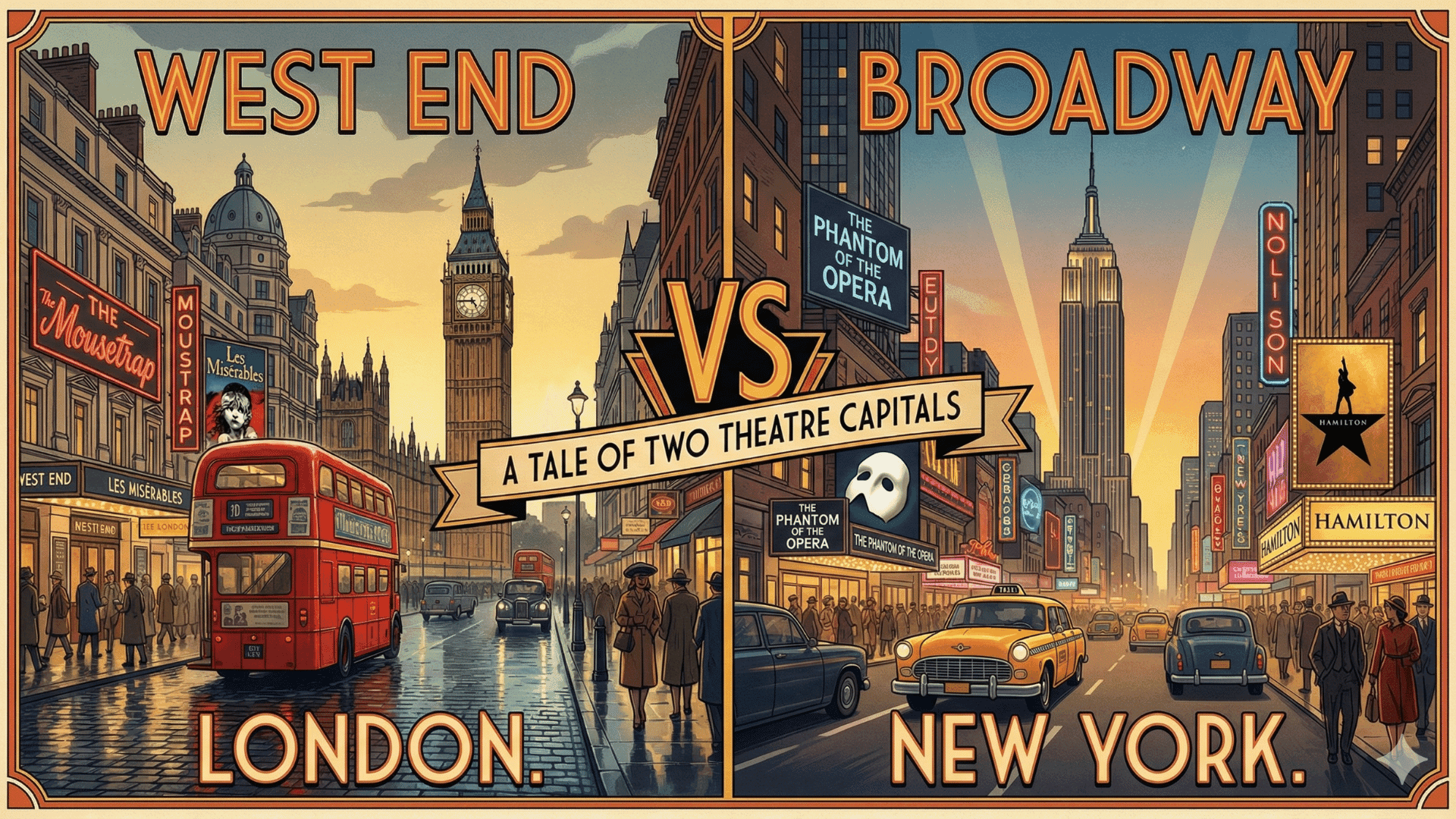
மேற்கு எண்ட் مقابل பிராட்வே: இரண்டு நாடக தலைநகரங்களின் கதை

மூலம் James Johnson

7 ஜனவரி, 2026

பங்கீடு

Broadway and the West End are two world theatre capitals.

மேற்கு எண்ட் مقابل பிராட்வே: இரண்டு நாடக தலைநகரங்களின் கதை

மூலம் James Johnson

7 ஜனவரி, 2026

பங்கீடு

Broadway and the West End are two world theatre capitals.

மேற்கு எண்ட் مقابل பிராட்வே: இரண்டு நாடக தலைநகரங்களின் கதை

மூலம் James Johnson

7 ஜனவரி, 2026

பங்கீடு

Broadway and the West End are two world theatre capitals.

மேற்கு எண்ட் مقابل பிராட்வே: இரண்டு நாடக தலைநகரங்களின் கதை

மூலம் James Johnson

7 ஜனவரி, 2026

பங்கீடு

Broadway and the West End are two world theatre capitals.

Theatre lovers often speak of "the West End" and "Broadway" as if they're interchangeable - two versions of the same thing separated by an ocean. Visit both, and you'll discover they're distinct theatrical cultures with different traditions, economics, and audience experiences.

If you're planning to see shows in either city (or both), here's everything you need to know about how they compare.

The Geography

West End

London's theatre district is concentrated around Shaftesbury Avenue, the Strand, and Covent Garden, but "West End" is more concept than precise geography. Theatres scatter across central London from Victoria to King's Cross, with most within walking distance of Leicester Square or Piccadilly Circus tube stations.

The density means you can see the exteriors of a dozen theatres in a fifteen-minute walk. It also means pre-theatre dining options are essentially unlimited, and you can stumble between venues for last-minute ticket decisions.

Notable venues outside the central cluster include the National Theatre (South Bank), The Old Vic (Waterloo), and various off-West-End houses that produce work that often transfers to larger stages.

Broadway

Manhattan's Theatre District occupies a more concentrated grid, roughly between 41st and 54th Streets from Sixth to Ninth Avenues. Only three theatres (including the Winter Garden and Palace) are actually on Broadway itself - the street, not the concept.

Times Square sits at the heart of the district, which means navigating tourist crowds, aggressive advertising, and sensory overload. The upside is that nearly every Broadway theatre is within a five-minute walk of any other.

Off-Broadway theatres scatter across Manhattan, from the East Village to Lincoln Center. Some of the most interesting work happens in these smaller venues.

The Money

Let's be direct: Broadway is more expensive.

Ticket Prices

Broadway averages:

  • Premium orchestra: $300-$500+

  • Regular orchestra: $150-$250

  • Mezzanine: $100-$175

  • Rear balcony: $60-$100

  • Discount/lottery: $30-$50

West End averages:

  • Premium stalls: £150-£300

  • Regular stalls: £75-£150

  • Royal Circle/Dress Circle: £50-£100

  • Upper Circle/Balcony: £25-£60

  • Discount day seats: £20-£40

At current exchange rates, comparable seats cost roughly 30-50% more on Broadway than in the West End. This is partly higher production costs, partly New York real estate, partly what the market will bear.

The Experience

Before the Show

Interval drinks represent the biggest cultural difference.

In London, pre-ordering interval drinks is standard. You buy your G&T before the show, it waits for you at a designated collection point during the interval, and you avoid the scrum at the bar. Most West End theatres have this system; most audience members use it.

On Broadway, you queue. Americans haven't adopted pre-ordering, so intermission involves a frantic rush to the bar, fifteen minutes of waiting, and often missing the start of Act Two. The drinks are also more expensive.

Programmes (or "programs" on Broadway) work differently too. West End programmes typically cost £5-15 and are sold by ushers in the auditorium. Broadway's Playbill is free, distributed at the door, and funded by advertising. The free Playbill is thin on content; a separate souvenir programme costs $20+.

Dress code is effectively non-existent at both. You'll see everything from jeans and trainers to evening wear. New York leans slightly more casual overall, but neither city will turn you away for underdressing.

During the Show

Running times are similar - most musicals run 2.5-3 hours with interval, plays 1.5-2.5 hours with or without.

Phone usage is policed more aggressively on Broadway, where ushers will intervene quickly. West End audiences seem marginally better behaved on this front, perhaps because warnings feel more stern in British accents.

Standing ovations are standard on Broadway regardless of quality. Standing ovations in the West End are reserved for genuinely exceptional performances. If a London audience rises, it means something; if a New York audience rises, it means the show ended.

Tipping doesn't apply directly to theatre, but Americans should note that West End ushers don't expect tips. They're paid staff, not tip-dependent workers.

After the Show

Stage doors work similarly in both cities. Actors often emerge after the show to sign programmes and take photos. Broadway stage doors tend to be more organised (sometimes with barriers and security); West End stage doors are often just... doors, with actors emerging onto public pavements.

The Programming

What Transfers Where

The transatlantic theatrical highway runs heavily in one direction: Broadway shows transfer to the West End more often than the reverse.

Hamilton, Wicked, The Lion King, Les Misérables - these originated on Broadway and established long-running London productions. The reverse journey is rarer but happens: The Play That Goes Wrong, Matilda, and Harry Potter and the Cursed Child all began in London before reaching New York.

Why the imbalance? American productions tend to have larger budgets and more aggressive commercial backing. British productions often develop through subsidised theatres (National Theatre, Royal Shakespeare Company, regional houses) before considering commercial transfer.

New Work vs. Revivals

Broadway runs more revivals of classic musicals - Oklahoma!, Sweeney Todd, Merrily We Roll Along, Cabaret return regularly in new productions. The West End tends toward longer original runs rather than cycling through revivals.

This means Broadway offers more chances to see reinterpretations of canonical work. The West End offers more chances to see shows in their original productions before they close.

Plays vs. Musicals

Both cities produce excellent plays, but the economics differ.

Broadway plays typically run as limited engagements with star casting. A show might run 12-16 weeks with a film actor in the lead, then close regardless of success. This creates urgency (see it now or miss it) but limits access.

West End plays can run open-ended if they find audiences. The Mousetrap has been running since 1952. Woman in Black has run since 1989. Even newer plays can settle in for multi-year runs if ticket sales justify it.

The Venues

Age and Character

West End theatres tend to be older. Many date from Victorian and Edwardian eras, with ornate interiors, cramped legroom, and varying accessibility. The buildings themselves are often Grade II listed, meaning renovations must preserve historical features.

Broadway theatres are a mix. Some (like the Lyceum) date from the early 1900s, but many were built or significantly renovated in the mid-20th century. They're generally larger and more standardised, with better sightlines but less individual character.

Size

Broadway houses are typically bigger:

Large Broadway theatres: 1,500-1,900 seats Large West End theatres: 1,000-1,500 seats

This affects both economics (Broadway can generate more per performance) and intimacy (West End shows often feel closer even from equivalent seat positions).

Accessibility

Broadway generally offers better accessibility. American theatres were more likely to be renovated or built after the Americans with Disabilities Act (1990), which mandated accessibility features.

West End theatres, constrained by historic building protections, often have limited step-free access, narrow corridors, and restricted sightlines for wheelchair users. Things are improving, but slowly. Always check specific venues if accessibility matters.

The Seasons

Broadway Season

Broadway thinks in seasons, roughly September-May. Major openings cluster in autumn (catching early Tony Award eligibility) and spring (late Tony eligibility). Summer tends quieter, with tourist-focused long-running shows maintaining business while new productions wait for fall.

The Tony Awards (June) drive the Broadway calendar. Shows time their openings to maximise Tony buzz, and Tony winners often see significant ticket sales bumps.

West End Season

The West End is less seasonal. Shows open year-round based on theatre availability and production readiness rather than awards calendars.

The Olivier Awards (April) matter but don't dominate scheduling the way Tonys do. Christmas is huge for family shows and pantomimes. Summer brings tourist audiences. There's no real "off-season."

Which Is Better?

The honest answer: both, for different reasons.

Broadway excels at:

  • Scale and spectacle (bigger budgets, bigger theatres)

  • Star casting (more film/TV actors doing theatre)

  • Revivals of classic musicals

  • The concentration of the district (easy theatre hopping)

  • The energy of opening nights

West End excels at:

  • Value for money (comparable quality, lower prices)

  • Historic venues (Victorian splendour)

  • Long runs (see shows before they close... eventually)

  • Theatrical diversity (more subsidised risk-taking)

  • Pre-ordered interval drinks (seriously, it's civilised)

The ideal approach: see shows in both cities. Watch how the same musical feels different in each context. Notice what each theatrical culture does well.

What to See Where

If a show runs in both cities, see it in London for value and intimacy, or New York for scale and star casting.

Currently in both cities:

  • Hamilton - Both productions excellent; London slightly cheaper

  • The Lion King - London production older but still stunning

  • Wicked - Similar productions; film release may affect both

  • Harry Potter and the Cursed Child - Original two part show in London, Condensed one part show in New York

London-only (or London-first):

Broadway-only (or Broadway-first):

  • Merrily We Roll Along (recently closed, but see the film)

  • Chess (current revival)

  • Ragtime (current revival)

The Bottom Line

West End and Broadway aren't competitors - they're partners in keeping English-language theatre vital. Shows flow between them, artists work in both, and audiences benefit from two thriving theatrical ecosystems.

If you're choosing where to see theatre, consider: New York for event theatre and star turns, London for value and historic atmosphere. If you can manage both, do.

Quick Links

London:

New York:

Everywhere else:

Two cities. Two theatrical traditions. One shared love of live performance. Book theatre in London and New York on tickadoo.

Theatre lovers often speak of "the West End" and "Broadway" as if they're interchangeable - two versions of the same thing separated by an ocean. Visit both, and you'll discover they're distinct theatrical cultures with different traditions, economics, and audience experiences.

If you're planning to see shows in either city (or both), here's everything you need to know about how they compare.

The Geography

West End

London's theatre district is concentrated around Shaftesbury Avenue, the Strand, and Covent Garden, but "West End" is more concept than precise geography. Theatres scatter across central London from Victoria to King's Cross, with most within walking distance of Leicester Square or Piccadilly Circus tube stations.

The density means you can see the exteriors of a dozen theatres in a fifteen-minute walk. It also means pre-theatre dining options are essentially unlimited, and you can stumble between venues for last-minute ticket decisions.

Notable venues outside the central cluster include the National Theatre (South Bank), The Old Vic (Waterloo), and various off-West-End houses that produce work that often transfers to larger stages.

Broadway

Manhattan's Theatre District occupies a more concentrated grid, roughly between 41st and 54th Streets from Sixth to Ninth Avenues. Only three theatres (including the Winter Garden and Palace) are actually on Broadway itself - the street, not the concept.

Times Square sits at the heart of the district, which means navigating tourist crowds, aggressive advertising, and sensory overload. The upside is that nearly every Broadway theatre is within a five-minute walk of any other.

Off-Broadway theatres scatter across Manhattan, from the East Village to Lincoln Center. Some of the most interesting work happens in these smaller venues.

The Money

Let's be direct: Broadway is more expensive.

Ticket Prices

Broadway averages:

  • Premium orchestra: $300-$500+

  • Regular orchestra: $150-$250

  • Mezzanine: $100-$175

  • Rear balcony: $60-$100

  • Discount/lottery: $30-$50

West End averages:

  • Premium stalls: £150-£300

  • Regular stalls: £75-£150

  • Royal Circle/Dress Circle: £50-£100

  • Upper Circle/Balcony: £25-£60

  • Discount day seats: £20-£40

At current exchange rates, comparable seats cost roughly 30-50% more on Broadway than in the West End. This is partly higher production costs, partly New York real estate, partly what the market will bear.

The Experience

Before the Show

Interval drinks represent the biggest cultural difference.

In London, pre-ordering interval drinks is standard. You buy your G&T before the show, it waits for you at a designated collection point during the interval, and you avoid the scrum at the bar. Most West End theatres have this system; most audience members use it.

On Broadway, you queue. Americans haven't adopted pre-ordering, so intermission involves a frantic rush to the bar, fifteen minutes of waiting, and often missing the start of Act Two. The drinks are also more expensive.

Programmes (or "programs" on Broadway) work differently too. West End programmes typically cost £5-15 and are sold by ushers in the auditorium. Broadway's Playbill is free, distributed at the door, and funded by advertising. The free Playbill is thin on content; a separate souvenir programme costs $20+.

Dress code is effectively non-existent at both. You'll see everything from jeans and trainers to evening wear. New York leans slightly more casual overall, but neither city will turn you away for underdressing.

During the Show

Running times are similar - most musicals run 2.5-3 hours with interval, plays 1.5-2.5 hours with or without.

Phone usage is policed more aggressively on Broadway, where ushers will intervene quickly. West End audiences seem marginally better behaved on this front, perhaps because warnings feel more stern in British accents.

Standing ovations are standard on Broadway regardless of quality. Standing ovations in the West End are reserved for genuinely exceptional performances. If a London audience rises, it means something; if a New York audience rises, it means the show ended.

Tipping doesn't apply directly to theatre, but Americans should note that West End ushers don't expect tips. They're paid staff, not tip-dependent workers.

After the Show

Stage doors work similarly in both cities. Actors often emerge after the show to sign programmes and take photos. Broadway stage doors tend to be more organised (sometimes with barriers and security); West End stage doors are often just... doors, with actors emerging onto public pavements.

The Programming

What Transfers Where

The transatlantic theatrical highway runs heavily in one direction: Broadway shows transfer to the West End more often than the reverse.

Hamilton, Wicked, The Lion King, Les Misérables - these originated on Broadway and established long-running London productions. The reverse journey is rarer but happens: The Play That Goes Wrong, Matilda, and Harry Potter and the Cursed Child all began in London before reaching New York.

Why the imbalance? American productions tend to have larger budgets and more aggressive commercial backing. British productions often develop through subsidised theatres (National Theatre, Royal Shakespeare Company, regional houses) before considering commercial transfer.

New Work vs. Revivals

Broadway runs more revivals of classic musicals - Oklahoma!, Sweeney Todd, Merrily We Roll Along, Cabaret return regularly in new productions. The West End tends toward longer original runs rather than cycling through revivals.

This means Broadway offers more chances to see reinterpretations of canonical work. The West End offers more chances to see shows in their original productions before they close.

Plays vs. Musicals

Both cities produce excellent plays, but the economics differ.

Broadway plays typically run as limited engagements with star casting. A show might run 12-16 weeks with a film actor in the lead, then close regardless of success. This creates urgency (see it now or miss it) but limits access.

West End plays can run open-ended if they find audiences. The Mousetrap has been running since 1952. Woman in Black has run since 1989. Even newer plays can settle in for multi-year runs if ticket sales justify it.

The Venues

Age and Character

West End theatres tend to be older. Many date from Victorian and Edwardian eras, with ornate interiors, cramped legroom, and varying accessibility. The buildings themselves are often Grade II listed, meaning renovations must preserve historical features.

Broadway theatres are a mix. Some (like the Lyceum) date from the early 1900s, but many were built or significantly renovated in the mid-20th century. They're generally larger and more standardised, with better sightlines but less individual character.

Size

Broadway houses are typically bigger:

Large Broadway theatres: 1,500-1,900 seats Large West End theatres: 1,000-1,500 seats

This affects both economics (Broadway can generate more per performance) and intimacy (West End shows often feel closer even from equivalent seat positions).

Accessibility

Broadway generally offers better accessibility. American theatres were more likely to be renovated or built after the Americans with Disabilities Act (1990), which mandated accessibility features.

West End theatres, constrained by historic building protections, often have limited step-free access, narrow corridors, and restricted sightlines for wheelchair users. Things are improving, but slowly. Always check specific venues if accessibility matters.

The Seasons

Broadway Season

Broadway thinks in seasons, roughly September-May. Major openings cluster in autumn (catching early Tony Award eligibility) and spring (late Tony eligibility). Summer tends quieter, with tourist-focused long-running shows maintaining business while new productions wait for fall.

The Tony Awards (June) drive the Broadway calendar. Shows time their openings to maximise Tony buzz, and Tony winners often see significant ticket sales bumps.

West End Season

The West End is less seasonal. Shows open year-round based on theatre availability and production readiness rather than awards calendars.

The Olivier Awards (April) matter but don't dominate scheduling the way Tonys do. Christmas is huge for family shows and pantomimes. Summer brings tourist audiences. There's no real "off-season."

Which Is Better?

The honest answer: both, for different reasons.

Broadway excels at:

  • Scale and spectacle (bigger budgets, bigger theatres)

  • Star casting (more film/TV actors doing theatre)

  • Revivals of classic musicals

  • The concentration of the district (easy theatre hopping)

  • The energy of opening nights

West End excels at:

  • Value for money (comparable quality, lower prices)

  • Historic venues (Victorian splendour)

  • Long runs (see shows before they close... eventually)

  • Theatrical diversity (more subsidised risk-taking)

  • Pre-ordered interval drinks (seriously, it's civilised)

The ideal approach: see shows in both cities. Watch how the same musical feels different in each context. Notice what each theatrical culture does well.

What to See Where

If a show runs in both cities, see it in London for value and intimacy, or New York for scale and star casting.

Currently in both cities:

  • Hamilton - Both productions excellent; London slightly cheaper

  • The Lion King - London production older but still stunning

  • Wicked - Similar productions; film release may affect both

  • Harry Potter and the Cursed Child - Original two part show in London, Condensed one part show in New York

London-only (or London-first):

Broadway-only (or Broadway-first):

  • Merrily We Roll Along (recently closed, but see the film)

  • Chess (current revival)

  • Ragtime (current revival)

The Bottom Line

West End and Broadway aren't competitors - they're partners in keeping English-language theatre vital. Shows flow between them, artists work in both, and audiences benefit from two thriving theatrical ecosystems.

If you're choosing where to see theatre, consider: New York for event theatre and star turns, London for value and historic atmosphere. If you can manage both, do.

Quick Links

London:

New York:

Everywhere else:

Two cities. Two theatrical traditions. One shared love of live performance. Book theatre in London and New York on tickadoo.

Theatre lovers often speak of "the West End" and "Broadway" as if they're interchangeable - two versions of the same thing separated by an ocean. Visit both, and you'll discover they're distinct theatrical cultures with different traditions, economics, and audience experiences.

If you're planning to see shows in either city (or both), here's everything you need to know about how they compare.

The Geography

West End

London's theatre district is concentrated around Shaftesbury Avenue, the Strand, and Covent Garden, but "West End" is more concept than precise geography. Theatres scatter across central London from Victoria to King's Cross, with most within walking distance of Leicester Square or Piccadilly Circus tube stations.

The density means you can see the exteriors of a dozen theatres in a fifteen-minute walk. It also means pre-theatre dining options are essentially unlimited, and you can stumble between venues for last-minute ticket decisions.

Notable venues outside the central cluster include the National Theatre (South Bank), The Old Vic (Waterloo), and various off-West-End houses that produce work that often transfers to larger stages.

Broadway

Manhattan's Theatre District occupies a more concentrated grid, roughly between 41st and 54th Streets from Sixth to Ninth Avenues. Only three theatres (including the Winter Garden and Palace) are actually on Broadway itself - the street, not the concept.

Times Square sits at the heart of the district, which means navigating tourist crowds, aggressive advertising, and sensory overload. The upside is that nearly every Broadway theatre is within a five-minute walk of any other.

Off-Broadway theatres scatter across Manhattan, from the East Village to Lincoln Center. Some of the most interesting work happens in these smaller venues.

The Money

Let's be direct: Broadway is more expensive.

Ticket Prices

Broadway averages:

  • Premium orchestra: $300-$500+

  • Regular orchestra: $150-$250

  • Mezzanine: $100-$175

  • Rear balcony: $60-$100

  • Discount/lottery: $30-$50

West End averages:

  • Premium stalls: £150-£300

  • Regular stalls: £75-£150

  • Royal Circle/Dress Circle: £50-£100

  • Upper Circle/Balcony: £25-£60

  • Discount day seats: £20-£40

At current exchange rates, comparable seats cost roughly 30-50% more on Broadway than in the West End. This is partly higher production costs, partly New York real estate, partly what the market will bear.

The Experience

Before the Show

Interval drinks represent the biggest cultural difference.

In London, pre-ordering interval drinks is standard. You buy your G&T before the show, it waits for you at a designated collection point during the interval, and you avoid the scrum at the bar. Most West End theatres have this system; most audience members use it.

On Broadway, you queue. Americans haven't adopted pre-ordering, so intermission involves a frantic rush to the bar, fifteen minutes of waiting, and often missing the start of Act Two. The drinks are also more expensive.

Programmes (or "programs" on Broadway) work differently too. West End programmes typically cost £5-15 and are sold by ushers in the auditorium. Broadway's Playbill is free, distributed at the door, and funded by advertising. The free Playbill is thin on content; a separate souvenir programme costs $20+.

Dress code is effectively non-existent at both. You'll see everything from jeans and trainers to evening wear. New York leans slightly more casual overall, but neither city will turn you away for underdressing.

During the Show

Running times are similar - most musicals run 2.5-3 hours with interval, plays 1.5-2.5 hours with or without.

Phone usage is policed more aggressively on Broadway, where ushers will intervene quickly. West End audiences seem marginally better behaved on this front, perhaps because warnings feel more stern in British accents.

Standing ovations are standard on Broadway regardless of quality. Standing ovations in the West End are reserved for genuinely exceptional performances. If a London audience rises, it means something; if a New York audience rises, it means the show ended.

Tipping doesn't apply directly to theatre, but Americans should note that West End ushers don't expect tips. They're paid staff, not tip-dependent workers.

After the Show

Stage doors work similarly in both cities. Actors often emerge after the show to sign programmes and take photos. Broadway stage doors tend to be more organised (sometimes with barriers and security); West End stage doors are often just... doors, with actors emerging onto public pavements.

The Programming

What Transfers Where

The transatlantic theatrical highway runs heavily in one direction: Broadway shows transfer to the West End more often than the reverse.

Hamilton, Wicked, The Lion King, Les Misérables - these originated on Broadway and established long-running London productions. The reverse journey is rarer but happens: The Play That Goes Wrong, Matilda, and Harry Potter and the Cursed Child all began in London before reaching New York.

Why the imbalance? American productions tend to have larger budgets and more aggressive commercial backing. British productions often develop through subsidised theatres (National Theatre, Royal Shakespeare Company, regional houses) before considering commercial transfer.

New Work vs. Revivals

Broadway runs more revivals of classic musicals - Oklahoma!, Sweeney Todd, Merrily We Roll Along, Cabaret return regularly in new productions. The West End tends toward longer original runs rather than cycling through revivals.

This means Broadway offers more chances to see reinterpretations of canonical work. The West End offers more chances to see shows in their original productions before they close.

Plays vs. Musicals

Both cities produce excellent plays, but the economics differ.

Broadway plays typically run as limited engagements with star casting. A show might run 12-16 weeks with a film actor in the lead, then close regardless of success. This creates urgency (see it now or miss it) but limits access.

West End plays can run open-ended if they find audiences. The Mousetrap has been running since 1952. Woman in Black has run since 1989. Even newer plays can settle in for multi-year runs if ticket sales justify it.

The Venues

Age and Character

West End theatres tend to be older. Many date from Victorian and Edwardian eras, with ornate interiors, cramped legroom, and varying accessibility. The buildings themselves are often Grade II listed, meaning renovations must preserve historical features.

Broadway theatres are a mix. Some (like the Lyceum) date from the early 1900s, but many were built or significantly renovated in the mid-20th century. They're generally larger and more standardised, with better sightlines but less individual character.

Size

Broadway houses are typically bigger:

Large Broadway theatres: 1,500-1,900 seats Large West End theatres: 1,000-1,500 seats

This affects both economics (Broadway can generate more per performance) and intimacy (West End shows often feel closer even from equivalent seat positions).

Accessibility

Broadway generally offers better accessibility. American theatres were more likely to be renovated or built after the Americans with Disabilities Act (1990), which mandated accessibility features.

West End theatres, constrained by historic building protections, often have limited step-free access, narrow corridors, and restricted sightlines for wheelchair users. Things are improving, but slowly. Always check specific venues if accessibility matters.

The Seasons

Broadway Season

Broadway thinks in seasons, roughly September-May. Major openings cluster in autumn (catching early Tony Award eligibility) and spring (late Tony eligibility). Summer tends quieter, with tourist-focused long-running shows maintaining business while new productions wait for fall.

The Tony Awards (June) drive the Broadway calendar. Shows time their openings to maximise Tony buzz, and Tony winners often see significant ticket sales bumps.

West End Season

The West End is less seasonal. Shows open year-round based on theatre availability and production readiness rather than awards calendars.

The Olivier Awards (April) matter but don't dominate scheduling the way Tonys do. Christmas is huge for family shows and pantomimes. Summer brings tourist audiences. There's no real "off-season."

Which Is Better?

The honest answer: both, for different reasons.

Broadway excels at:

  • Scale and spectacle (bigger budgets, bigger theatres)

  • Star casting (more film/TV actors doing theatre)

  • Revivals of classic musicals

  • The concentration of the district (easy theatre hopping)

  • The energy of opening nights

West End excels at:

  • Value for money (comparable quality, lower prices)

  • Historic venues (Victorian splendour)

  • Long runs (see shows before they close... eventually)

  • Theatrical diversity (more subsidised risk-taking)

  • Pre-ordered interval drinks (seriously, it's civilised)

The ideal approach: see shows in both cities. Watch how the same musical feels different in each context. Notice what each theatrical culture does well.

What to See Where

If a show runs in both cities, see it in London for value and intimacy, or New York for scale and star casting.

Currently in both cities:

  • Hamilton - Both productions excellent; London slightly cheaper

  • The Lion King - London production older but still stunning

  • Wicked - Similar productions; film release may affect both

  • Harry Potter and the Cursed Child - Original two part show in London, Condensed one part show in New York

London-only (or London-first):

Broadway-only (or Broadway-first):

  • Merrily We Roll Along (recently closed, but see the film)

  • Chess (current revival)

  • Ragtime (current revival)

The Bottom Line

West End and Broadway aren't competitors - they're partners in keeping English-language theatre vital. Shows flow between them, artists work in both, and audiences benefit from two thriving theatrical ecosystems.

If you're choosing where to see theatre, consider: New York for event theatre and star turns, London for value and historic atmosphere. If you can manage both, do.

Quick Links

London:

New York:

Everywhere else:

Two cities. Two theatrical traditions. One shared love of live performance. Book theatre in London and New York on tickadoo.

இந்த பதிவைப் பகிர்க் க:

இந்த பதிவைப் பகிர்க் க:

இந்த பதிவைப் பகிர்க் க: